

Introduction to Loan Capital
Loan capital is that part of your business finance which is made by way of loans. Generally the security for the loans are the assets of the business and sometimes the personal assets of the owner.
The loan capital is provided by a lender and your business is the borrower. The loan will be subject to lending criteria which need to be satisfied before the loan is made.
Additionally loan capital is normally evidenced by a note or document which specifies the amount, interest rate, and date of repayment. It is important to realize that failure to make repayments on loans can result in penalties or ultimately winding up proceedings against the business.
Short term Loan Capital
Short term loans are repayable in less than one year and are part of current liabilities in the balance sheet. Generally they include short term bank loans and overdrafts.
Long term Loan Capital
Long term loans are repayable in more than one year and are part of the long term liabilities in the balance sheet. Generally long term capital falls within one of two categories either bank loans or mortgages. Mortgages are long term loans with which the business purchases property.
Market Interest Rate
The interest rate is the rate at which a borrower pays interest for the use of a lenders money. It is important to realize that the interest rate is the cost of obtaining money.
Additionally the market interest rate is simply the interest rate existing at a particular time as determined by the supply and demand of money in the money market.
Like any commodity, if demand exceeds supply the price will increase, and likewise if supply exceeds demand the price will fall.
In this case the commodity is money, and the price is the market interest rate. Consequently as the demand for money exceeds supply the market interest rate rises, as the supply of money exceeds demand the market interest rate falls.
The supply and demand for money, and therefore the money market interest rate, is a function of many factors including, inflationary expectations, risk, availability of alternative investments, economic and political considerations, taxes and liquidity.
Types of Loan Capital
There are many different types of business loans available including the following:
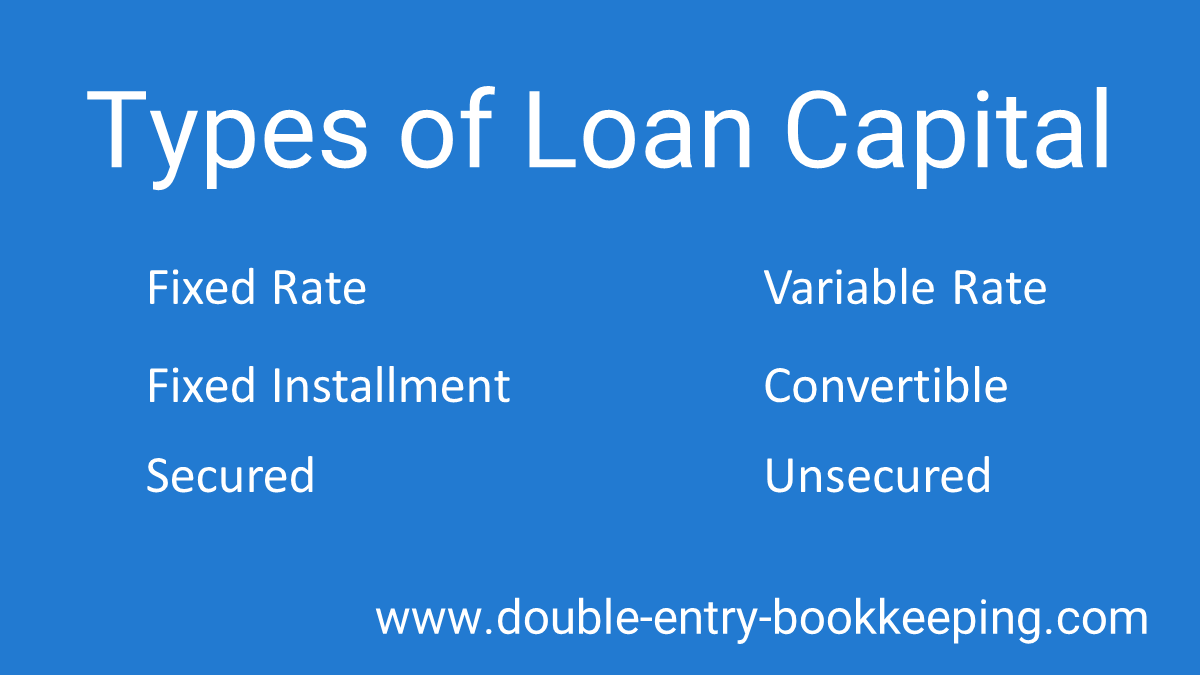
Fixed Rate
Fixed rate loans have a fixed interest rate throughout the term of the loan.
The advantage of a fixed rate loan is that it allows a business to plan its future debt repayments as these do not vary over time. Additionally it safeguards the business against any increases in interest rates over the term.
The disadvantage of a fixed rate loan is that in the event that interest rates fall, the business is left with the higher fixed interest rate until the end of the term unless is pays a penalty to terminate the loan agreement.
Fixed Installment
Fixed installment loans have fixed amount scheduled repayments made throughout the term of the loan.
Secured
Secured loans as the name implies are secured on the assets of the business and on occasions on the personal assets of the owner. A mortgage is a particular type of secured loan the purpose of which is to purchase property. To secure the mortgage loan, the borrower (mortgager) transfers the interest in the property to the lender (mortgagee). It is important to realize that in the event of non repayment of the loan, the lender may foreclose and take the property.
Variable Rate
Variable rate loan capital has an interest rate which changes throughout the term of the loan and is usually set in relation to an underlying bank rate such as Base rate or LIBOR.
Unsecured
Unsecured loans do not require any security and includes such items as credit cards and occasionally bank overdrafts.
Convertible
Convertible loans are loans which can change from one type to another during the term of the loan.
How do you Record Loan Capital?
The General Ledger records the bookkeeping transactions relating to loans.
To illustrate, suppose a business obtains a loan from a lender of 10,000. If the loan is paid into the current bank account the journal entry would be.
| Account | Debit | Credit |
|---|---|---|
| Bank Current Account | 10,000 | |
| Loans | 10,000 | |
| Total | 10,000 | 10,000 |
This reflects the cash receipt into the bank account, and the liability of the business to the lender.